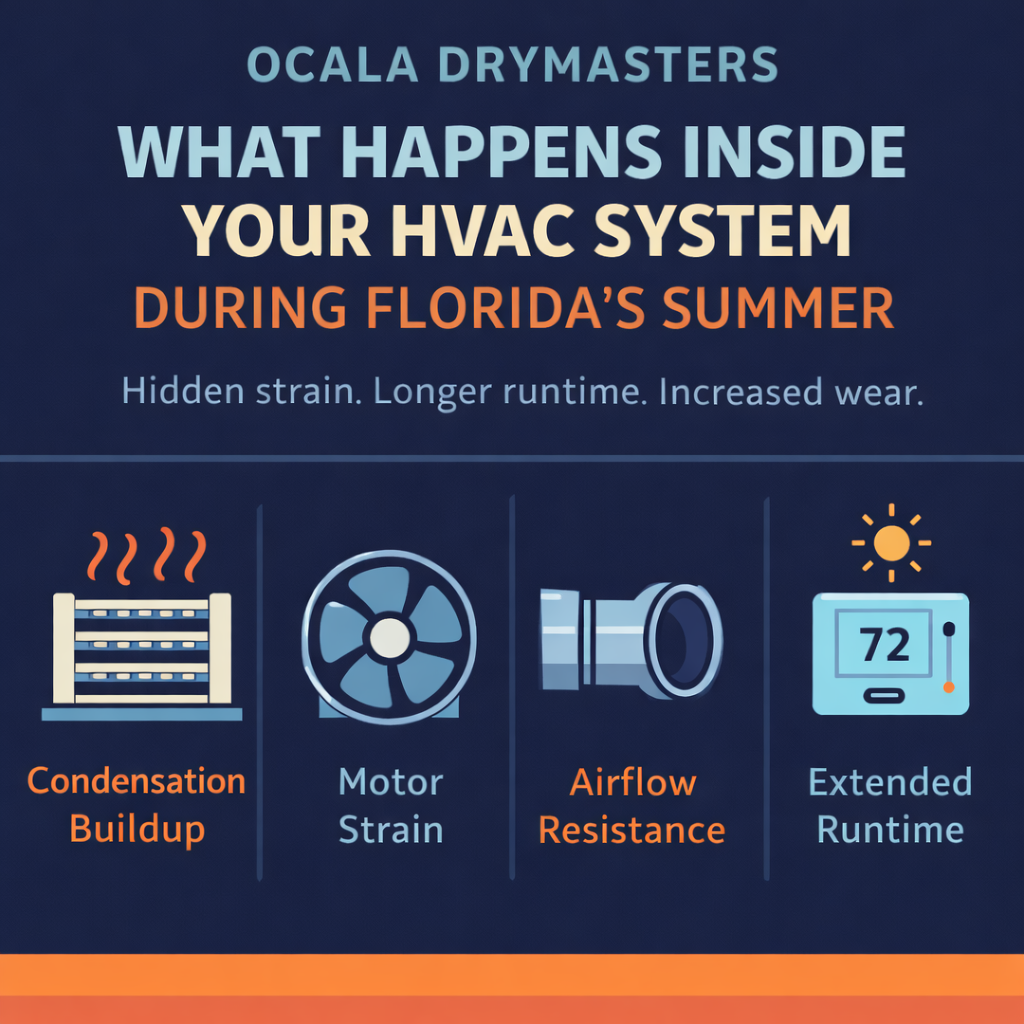
Florida’s cooling season doesn’t last three months — it can stretch across most of the year. That extended runtime changes how a Florida HVAC system in summer behaves internally. While your thermostat simply reads a number, inside the system, components are cycling longer, collecting more debris, and operating under sustained demand.
Most homeowners only think about their AC when something feels wrong. But by the time comfort drops, internal strain has often been building for months.
Here’s what actually happens inside your system during Florida’s long cooling season — and why understanding it matters.
In northern states, HVAC systems alternate between heating and cooling seasons. In Florida, cooling dominates.
Longer runtime means:
According to the U.S. Department of Energy, cooling costs represent a significant portion of annual energy use in warm climates
👉 Energy.gov – Air Conditioning Efficiency
When runtime increases, even small inefficiencies compound quickly.
During extended cooling, evaporator coils continuously remove heat and humidity from indoor air. In Florida, high moisture levels mean coils are almost always managing condensation.
Over time:
This is one reason internal cleaning becomes more important in humid regions. Professional Residential & Commercial Air Duct Cleaning addresses buildup that impacts airflow and internal component performance.
Your blower motor pushes cooled air through duct lines. When airflow resistance increases — even slightly — the motor compensates.
During Florida summers:
Extended runtime without airflow optimization shortens component lifespan. This is why many HVAC failures occur mid-summer — not because of one event, but because of accumulated stress.
Every cooling cycle pulls airborne particles into return vents. Over months of extended cooling, debris builds up inside duct lines.
That buildup can lead to:
If your home feels dusty even after cleaning, internal duct accumulation may be contributing. 👉 Why Your Home Still Feels Dusty After Cleaning
Reducing internal buildup before peak heat helps maintain smoother airflow all season.
Cooling in Florida isn’t just about temperature — it’s about moisture removal. When internal components collect buildup, humidity control becomes less effective.
That can result in:
The Environmental Protection Agency explains that HVAC performance directly affects indoor air quality and moisture control
👉 EPA – Indoor Air Quality
Keeping internal components clean helps maintain both temperature and humidity balance.
Extended runtime combined with internal buildup leads to:
HVAC systems in Florida already operate under heavy demand. Allowing small restrictions to persist increases wear across multiple components.
Scheduling preventative service before or during early summer reduces the compounding effect of long cooling cycles. You can easily 👉 Book an Appointment to have your system evaluated before peak heat hits.
During summer, indoor heat load matters. A restricted dryer vent traps hot air inside your home, forcing your cooling system to work harder.
If your laundry area feels hot or drying times increase, pairing HVAC evaluation with professional Dryer Vent Cleaning improves overall efficiency and reduces added strain.
Q: Is summer really harder on HVAC systems in Florida?
Yes. Extended runtime increases wear and internal buildup faster than in shorter cooling climates.
Q: How often should internal components be evaluated?
Annual inspection is recommended in Florida due to longer cooling seasons.
Q: Can buildup really affect humidity control?
Yes. Dirty coils and airflow restrictions reduce moisture removal efficiency.
Q: How do I schedule service?
You can 👉 Contact Us or directly 👉 Book an Appointment
Ocala • Belleview • Summerfield • The Villages • Dunnellon • Silver Springs • Wildwood • Citra • Reddick • Fort McCoy
A Florida HVAC system in summer isn’t just “running.” It’s operating under extended demand for months at a time. Internal components collect debris, condensation cycles increase, and motors work longer hours.
Understanding what happens inside your system during Florida’s long cooling season helps homeowners take proactive steps — not reactive ones.
If your system hasn’t been evaluated recently, now is the right time to prepare before peak heat fully sets in.